1943 - 1950
No, there's nothing half so sweet in life
as love's young dream . . .
Thomas Moore
Jobs at Velox Will Keep Them Together
An article in the January, 1943, Spokane Daily Chronicle included pictures and the following:
This trio of girls went through grade school, through high
school, will graduate together, and, after graduation
Friday, January 15, from West Valley High School will enter
war work together at the Velox Naval Supply Depot. Betty
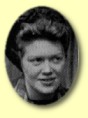
Smith is at the left, Leta Keener is in the center and Ruth
Panther at the right. The graduation will be at the
Desert Hotel on the 15th. The trio went through high school
in three-and-a-half years.
|
We were classified as trainees, and our pay was $100 a month! I paid some of it to Mom and George for room and board. I was able to buy all the clothes I wanted, and also put some aside into war bonds. The working world could be, I realized with alarm, quite cruel! No more summer vacations . . .! ! ! How could anyone survive?
|
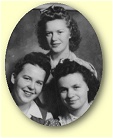
Velox Girls
|
The draft was imminent for Bob. He was called for his physical and he immediately enlisted in the navy (preferable to the army).
The following two months after my graduation and while I was working, Bob stopped coming over. His family and my family did not have telephones, so I tried to contact him at work using a neighbor's phone. He was unbelievably cool to me, and I
learned that he was dating someone else -- Frances Mohney. She was related to Bert Hayward, a friend of his brother, Harold. I heard the consolation, "He is just sowing his wild oats before he leaves for war duty. He'll be back." I was stunned! I thought he would have had more respect for me than to leave me hanging like that -- we were engaged.
I returned his ring.
This was a very hard time -- I was ill for several days and I could not eat!
Being the survivor that I am, and remembering my jealousy another time when we broke up (my idea but we both agreed to it) I began to accept dates with others. I decided to spend my new $100-a-month income on clothes and on having fun.
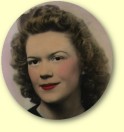
Leta Keener
|
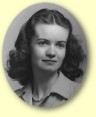
I had my high school graduation picture retaken by a very well-known photographer, Fred DesIslets. The pictures were much better than the ones taken originally. I bought a raincoat and an exquisite gold crepe dress that had gold nail-head trim. And, I bought a white formal that really fit me beautifully -- I weighed 112 pounds and was 5 ft. 3 1/2 inches tall.
|
When once we were at Shangri-la (the name of Betty Smith's family place on Newman Lake) I, for the first time, decided I would like to try drinking. I had never cared about drinking alcohol; however, some of those whom I was with occasionally would drink on weekends. Deciding, "What the heck, . ." I had some beer and then some wine. I drank just enough to think I could question good friend, Betty, about what boyfriend she was interested in. She was very private where her dates were concerned. I thought she would tell me all the details, but she had very little to say, and just laughed at me for trying to pry into her secrets.
Bob was inducted into the Navy on March 10, 1943. He left for boot training on March 17th, and was sent to Farragut, Idaho, where he was in the Camp Hill Section. Farragut, during wartime, became Idaho's Largest city.
Bob began calling me at my office and asking if I would consider going out with him when he had his first leave.
Asking Mom if she thought he loved me, she answered, "I know he does, and you love him, too!" So I considered and said "Well . . . Okay."
|
Bob had a couple of grueling months in boot camp while he was being shaped-up for the US Navy. He was extremely nervous when he picked me up for our first get-together. We drove along the river and parked just above Upriver Dam. He
asked me if I would take back his engagement ring. When I did, he immediately began to cry which totally surprised me, as he never, never before had shown much emotion.
|
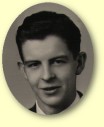
Bob Nance
|
On another leave, we went together to a jewelry store where I bought a gold locket for Bob to carry wherever he was sent with the USN. We had "LETA" engraved on the front of the heart-shaped locket. I presented it to him, and he put a picture of me inside. He carried it that tiny pocket in the pants of his "blues" uniform.
I got to meet Bob 's nephew, Jackie (John) Nance. He was eight and I was 18. He was the the son of Bob's half-brother, John. Later years, John Nance was a correspondent (journalist) for the Associated Press in the war zones of Cambodia and Vietnam. He also was an author and wrote several books, among which was "The Gentle Tasaday." He was acclaimed for this book and was interviewed on TV's Book Beat. There was a foreword in the book by Charles A. Lindbergh. Jack wrote in the flyleaf of our book that I was the girl he had wanted to kiss on Grandma Nance's front porch in Millwood.
Bob chose to go into radio, and was sent to Boulder, Colorado, for training at the University of Colorado. He was inspired to learn code by my brother Dennis, who was a radioman aboard ship, the USS San Francisco. In Boulder, there were a lot of Japanese who were teaching their language to Americans at the University. And one such family lived on the ground floor of the house where we lived.
I was looking forward to my first vacation from work, coming up in July. Of course, Bob was urging me to come to Boulder to visit him. My step-brother, Willard, was stationed outside of Denver at Lowry Field with the Army Air Force, and I also wanted to see him, so I thought it a great idea to go see them both.
Aunt Ida Ward and Mom made me promise I wouldn't get married while there -- they wanted me to wait until after the war and have a big wedding.
At work, I received a telegram:
WUC12 9 DENVER COLO JUL 3 853A = MISS LETA KEENER = NAVAL
SUPPLY DEPOT = WILL MEET YOU AT THE STATION. HAVE MADE
RESERVATION = WILLARD
I took a train to Denver, then, by bus, I arrived in Boulder, where I was met by Bob. Together we found the Hotel Albany where Willard had made my reservation.
We were ecstatic. This was a lovely, quiet, college town, and we were so young and in love. We made hasty wedding plans, the first of which was sending a telegram to my place of employment:
AM BEING MARRIED ON SATURDAY.
PLEASE ACCEPT MY RESIGNATION.
Bob was only 20, and I was 18 and one-half. I was of legal age, Bob was not. Bob had to obtain a letter from his mother giving permission for him to marry.
We looked the prospects of the town over for an apartment, and found a two room apartment upstairs over the home of Mr. and Mrs. Harry Hamm. They lived in the basement and rented their main floor to a Japanese family. They charged us $16 a month for rent -- all furnished.
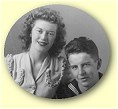
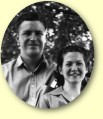
Bob and
Leta Nance
|
We were married the following Saturday, July 17, 1943, at the home of the Navy Chaplain, William Brooks. Bob wanted to order a gardenia corsage for me, because of my love of gardenias, but the florist told him brides should wear pretty colors, so I was given a large rosebud corsage.
|
|
Wonderful Willard was in attendance to give me away. When the Chaplain asked, "Who gives this woman in marriage?" he said he was as nervous as we were when he had to answer, "I do." Bob's buddy, Thor and his wife, Jean, were our attendants.
|
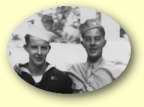
Bob and Willard
|
After our marriage ceremony and return to Boulder, our landlords invited us all to return to their house for some good old cold lemonade which was very welcome on that hot July day.
We took a bus to Denver for a night of celebration. Dinner was in a nice restaurant, but no drinks were served there. So Willard left to get a bottle of champagne. We had one of the waiters open it for us. It opened with a deafening POP, and the
champagne spewed and bubbled all over the floor. Conversation in the restaurant stopped instantly as everyone tried to figure out what the disturbance was. Waiters appeared to mop up, and assured our group that it was all right.
We went to Denver’s Playland, where we rode on a roller coaster that tipped extremely sideways while it was going up, down and around.
Then we danced.
I couldn’t have known our future would not include lots of Saturday nights of dancing. Bob must have thought it was only just a part of the courting procedure! Alas!
At the dance pavilion, we danced to music by a band of that time, Richard Himber. Bob told several sailors from the Navy School who knew him that we had gotten married, but they didn't believe us until we showed them my wedding ring.
Robert Smith Surtees wrote:
These sort of boobies think that people come to balls
to do nothing but dance; whereas everyone knows that
the real business of a ball is either to look out for a
wife, to look after a wife, or to look after somebody
else's wife.
Thorsons and Bob and I had rooms at the Kenmark Hotel, and Willard returned to his base. Thor and Jean told the hotel management that we wanted to be awakened at 5 o'clock. So . . . at that ungodly early hour, our phone rang. Fact is, as we told our "friends," we were just beginning to get to sleep!
As a new bride, I tried to learn to cook when everything I needed was rationed -- a bad beginning. It was quite interesting. We had the first gas stove I had tried to use, or for that matter ever seen, and, of course, I didn't know anything about using it or cooking!
I got a job at the Kress dime store in Boulder. I worked at the jewelry counter. This filled in my time when Bob was restricted to the base. He had hurt his ankle playing basketball and was not allowed to leave for a couple weeks until it was completely healed.
|
A lovely park was in the center part of town which had a brook running through. We lived close to a wooded area where we hiked and took pictures of ourselves with a "delayed action" camera. The one where I sat on a wishing well and Bob set the camera and rushed to sit beside me was a classic.
|
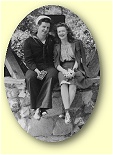
Boulder Park
|
Though we travel the world over to find the beautiful, we must carry it with us or we find it not . . . Ralph Waldo Emerson
Bob and I left Boulder by train on October 1 -- it was snowing! Bob was transferred to Port Blakely, Washington, on Bainbridge Island. He began school to learn specialized code. The men were having training that was classified and they were not to tell anyone the nature of this training -- not even their wives. Now I am telling you that they received and copied down code using LONG typewriter keyboards with Japanese characters on the keys.
I stopped off in Spokane and Bob stayed on the train for Seattle. On Bainbridge, he met a Navy couple, Carman and Wayne "Shep" Sheppard. They had living quarters on a houseboat on Lake Union in Seattle. Bob was able to get us a room on the same houseboat. We shared a bath, and had to cook on a hotplate. It was okay.
Immediately upon arrival in this moist climate, I became sick with a case of the flu. I must have contracted my illness on account of leaving mile-high Denver to sea-level Seattle in a matter of two weeks' time.
Carmie worked in the Winslow-Marine Shipyards on Bainbridge Island, and commuted every day by ferryboat. I got work in the shipyard' s pipeshop as a pipefitter's helper. I joined the Steamfitters Union and made 95 cents an hour. The four of us, early
every morning on our way to the island, stopped at a coffee shop by the ferry docks and had coffee and chocolate donuts.

Yeomalt Lodge
|
We finally moved to Bainbridge to a place called Yeomalt Lodge. Opal came to stay with us. She liked to cook so we gave her the job. I still didn't like to cook, but I was glad to do the cleaning up afterwards.
|
Yeomalt Lodge was a complex of dilapidated, mellowed, ivy covered buildings. The owners were an English couple by the name of "Peeps." Mr. Peeps was a pipe-smoking, distinguished gentleman, but Mrs, Peeps was a short, round, watery-eyed,
not-so-classy female. Our rented house had ivy growing wildly in through the walls, seemingly had newspapers as insulation in the quilts and comforters, and had mice running happily through the walls. And it had something else --
Opal had made some sweet rolls, and left them on the kitchen table for us to enjoy. These goodies mysteriously disappeared. She, of course, thought Bob and I had eaten them. Later, we found a hole in the bathroom wall, and we were able to see a couple of the rolls therein. And, seeing several other articles in there, we concluded we were sharing living quarters with pack rats!
On base, Bob proved to be quite a natural pool-player. Also, just learning tennis, he often was better than the players who were teaching him to play.
|
Entering and leaving the Naval base, Bob met a guard -- a very friendly Marine from Birmingham, Alabama. Bill Ridenhour, dark hair and "Frank Sinatra-type" thin, was brought home and introduced to Opal. They liked each other! Opal "the unobtainable," had finally met her match!
They were married in the chapel on base April 15, 1944, by the Marine Chaplain with Bob and me in attendance.
|
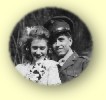
Opal Keener and
Bill Ridenhour
|
|
|
We had word in the meantime, that Dennis had met his "pen pal," Florence Whitworth, from Syracuse, New York. They were married February 14, Valentines Day. The way they became acquainted was Florence's cousin on board the San Francisco showed a picture of her to Dennis. He thought she was very pretty (she was!) They began corresponding. Dennis, now an Ensign and very handsome in his officer's uniform. They were a beautiful couple. And we were lucky to have Dennis and
Florence close by in Bremerton for the duration of WWII.
|
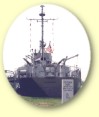
One-hundred eighty foot minesweepers were being built in the Winslow Marine Shipyard. We young girls had a working knowledge of the ship's terminology from bow-to-stern. We had to work with the ship's blueprints. So when the new, young sailors just assigned aboard their ship would look the minesweepers over, we regularly made silly remarks within their hearing such as: "Now, this is the sailors' bedroom (crew's quarters); and this is the kitchen (galley); and this is their dining room (mess hall); and the officers' bedrooms (wardrooms)." Those superior glances the novice sailors gave each other were priceless! . . .These girls don’t know anything!
At the dedication of one minesweeper, the U.S.S. HAZARD, I was asked to give the dedication. I read my speech (written for me) while standing on the new sweeper's deck. I was filled with patriotism. I received a letter of appreciation from the ship's commanding officer...
Besides building minesweepers, many ships from Russia were repaired in the Winslow Shipyards. The Russian crews could always be detected while they were on shore leave, because they did not wear uniforms -- but stark, black civilian suits.
On a noon hour we girls once were allowed aboard a Russian ship. We were treated cordially. The crew invited us by sign language (sort of) to join them at their table for soup. It appeared to be really thin and watery. We politely explained that we had already had our lunch. The ships were not very clean as their animals and chickens were aboard -- sooner or later they would become meals for hungry Russian sailors.
In the shipyard's newspaper, under the heading, "Valve Testing Is Fun," was a picture of me (a helper) and Jim Turner (a pipefitter). It mentioned:
|
|
Jim is a valve tester from way back, but Leta is new at the business.
Before coming here she was an office worker at the Naval Supply
Depot at Velox (which covers 55 acres under one roof, 'tis said).
Leta is Mrs. Nance. Her husband is a Radioman 3/C (third class)
stationed on Bainbridge Island.
|
I was pictured there wearing the standard scarf covering my hair, as it was necessary to keep one's hair out of whatever. I usually wore one of Bob's navy neckerchiefs to tie up my hair, as did lots of young married naval brides. The
message: "I'm married to a sailor -- I'm not looking."
From Yeomalt Lodge, we moved to a wartime housing project; a row of gray-painted units. Our address was 33 Winslow Drive, Winslow, Washington. There was a small woodshed in front of each unit for garbage cans, and for the wood we used in our cook stoves.
At this point because Opal was not with us, I really had to cook! On a wood-burning stove! I was shocked when I realized I was on my own and had to produce three meals everyday!
I bought a wash tub and washboard at the local store in Winslow. I washed our clothes, including Bob's sailor uniforms (whites) by hand, and hung them outside to dry. This was a far cry from my grandmother's day when she washed with her up-to-date Easy washer that could also spin-dry! I learned to "square" the white sailor hat before drying it. The hat had to be dried with the four corners creased -- never left round -- this would have indicated the wearer was a "nerd" or something.
June 6, 1944, was called D-Day. Nearly all of Western Europe had been occupied by Nazi Germany for four years. The people of the occupied counties were starving, being shipped in boxcars to forced labor and concentration camps.
On this day,
after weeks of building up an invasion, the free world Allies invaded occupied France. They landed on five beaches; two landings of which were made by Americans, two by the English, and one by the Canadians. Involved was a fleet of 5,000 ships carrying 200,000 servicemen.
Early in 1945 we moved into a darling, cozy one-room house overlooking the ocean at Port Madison. Some friends we knew were just vacating it, so we were able to get possession. It was actually very spacious and nicely furnished. Our landlady was
Mrs. McCurdy, who told us always she was tired!
We had many friends among the navy personnel. To name some were: Wayne "Shep'' and Carmie Sheppard, Rupert and Goldie Starr (from Texas) Margie Parker -- I don't remember her husband's name. One couple we were spending some time with were quite amusing to me. Her speech was such that I chided her when she said, "Where do youse want to go?" I told her she should say, "you instead of youse. " And she said, "No, I'm not talking to just you, I'm talking to both of youse!"
In the Winslow Shipyard, the women doing defense work were nearing the end of the critical wartime requirement. We were told our services would no longer be necessary after the first of the year (1945). This prompted me to find work in Seattle.
At Dunn & Bradstreet in Seattle, I was again commuting by ferry -- living on Bainbridge Island and working in Seattle. After a couple of months' work updating business records, and riding the ferry, I was happy when I heard of an opening for office
work back in the shipyards.
I got a job as junior clerk in Warehouse #1. An article in the shipyard's newspaper mentioned my position, and stated that I was married to Robert Nance, a Radioman 2/C. Bob didn't make 1/C Petty Officer rating.
Dictators ride to and fro upon tigers which they dare not dismount And the tigers are getting hungry . . .
From "While England Slept" by Winston Churchill
On April 12, 1945, I was at work when the news came on the radio that the Allies reached the Elbe; and we also received the sad news that President Roosevelt had just died. He had been the only president I could remember, as he was elected when I was in
third grade. (He was serving a fourth term).
Hitler's last day alive was the 30th of April. He and his girlfriend, Eva Braun, committed suicide as the Russians fought their way to his air raid shelter.
On May 2, Berlin surrendered. For all purposes, the war in the European theater was over. And that was quite a relief to all of the countries.
In 1945, Mother's Day, Opal was three months pregnant when Bill was sent to Norfolk, Virginia. He was put aboard an aircraft carrier, but, said he, "I wasn't in the Marines to be on any old ship." He was chomping at the bit to get out of the service and back to Opal.
|
I was pregnant too. Back in Spokane, Leo and Phyl were parents of their first-born, Karyl, and Opal and Bill were expecting their baby in November.
|
|
When I was three months into my pregnancy I quit working. I bought a box of blue baby yarn (I wanted a boy) and I bought a "How To" book on knitting and crocheting. I made several baby garments and as I learned to knit, I found I really loved it.
I went to Bremerton and Florence and I went together to the Navy doctors in Bremerton; She was expecting too, and we were both due the first week in January.
Florence was very naive. So when we were at the doctors' and she was asked to go into the bathroom to bring back a urine specimen, the nurse asked her, "Did you happen to dip this out of the toilet?"
"Well, yes," she said, "How did you know?" The nurse answered, "Because it was cold!"
On July 16, 1945, at 6 a.m. in New Mexico, the United States exploded an atom bomb. The decision to use this mechanism depended on President Truman. He decided that 200,000 American lives could be saved if it were used, and probably even more
lives including those of the other nations.
On August 6, 1945, I was at home listening to the radio when I heard the 'earth-shaking' news: "The United States has dropped an atom bomb on the town of Hiroshima. It destroyed broadly speaking the whole city and all living things therein." The bomb left complete destruction. Certainly, the Japs would soon surrender.
People were wondering, "What is this bomb?" Looking back, I think of this as one of the greatest events of history occurring during my lifetime.
We were very hopeful that this would soon end the war and allow us to return to civilian life. Up until that day, we weren't sure if peace would ever come.
Looking out across the beautiful bay, I wanted to always remember the joyful feeling I felt and this moment. I wanted to keep a mental picture of the blue Puget Sound so beautiful and sparkling in the afternoon sun and how it felt after so long a time to be finally at peace!.
Three days later, we again bombed a Japanese town, Nagasaki, with similar results. On August 14, Emperor Hirohito ordered a cessation of hostilities, and the next day V-J Day (Victory Japan) was announced.
Bill, in Norfolk, had enough points to get a discharge, so he was issued $46 to take him back to Birmingham -- the city where he lived when he enlisted. He needed money enough to get to Spokane! That left him a little short of fare! In September, Bill was out of the Marines and back in Spokane and civilian life.
In November, their baby girl, Kristi, was born. I was most anxious to get to Spokane to see her.
In December Bob was discharged from the Navy at Bremerton, and we were in Spokane for Christmas.
Out of the service--at last
Leo and Phyl, and also Opal and Bill lived in a temporary housing project in Hillyard, Coplen Park. Bob and I were able to rent a unit in the same complex, and we lived there until April.
Our baby was due January 1, 1946, and I was miserable going into "overtime." I contracted Dr. Marjorie Heitmann, the doctor who delivered for both Phyl and Opal. Dr. Heitmann had me come in for induction when I was five days overdue. As usual with a
first baby, I had a long labor, and was given a drug that was called twilight sleep, which put me really out. The next morning, January 6, a nurse awakened me and announced, "You had your baby last night, Mrs. Nance. You had a boy. Barry Richard weighed 8 lbs. 2 1/2 oz."
Bob came in early in the morning to check out his new baby son, and together we went to the nursery at the old St. Luke's Hospital. A nurse held newborn Barry up to the window for us to see. New father said, "He doesn't look very bright, does he?" It seems he was a little at a loss for an appropriate comment.
The news from Bremerton was that Barry's cousin, Tom, was born the day before on January 5. He weighed 9 lbs. On February 2, Bob got his first job after discharge from the Navy. He was an apprentice machinist for the Spokane Manufacturing Company. Leo was employed there as a Master Mechanic/Tool and Die Maker. Phyl's Uncle Clarence was one of the owners.
In April we bought my grandparent Ward’s four-room house next to my mother and step-father. It cost us $3200 through a Veterans' Administration loan. The loan was contingent upon our putting on a new roof. The basement had a dirt floor so we also had to have concrete poured in. Then we began painting and a continuous fixing up and remodeling to last until 1980. We paid $27.78 per month.
Also in April, Bob took his examination for amateur radio to get his "ham" license. Dennis had previously received his license, W7KQW, and had again inspired Bob to follow that line. Bob's call letters were W7KYY.
In July, we had our first vacation. We visited Dennis and Florence in Bremerton and while there, we planned to go salmon fishing. We hesitated about driving our old-kind-of-a-car to the coast because we were taking our baby along with us. Our
Plymouth was 12 years old. Bob's brother, Paul, generously loaned us his car, and we left ours for them to use. We intended to be gone only two weeks.
When we arrived in Bremerton with our six-month old baby, we were going to stay with Dennis and Florence and meet their six-month old baby. Dennis was still in the navy and waiting for his enlistment to be up.
When we arrived in Bremerton, Bob immediately became very ill, and we didn't know any doctors over there. Out of the phone book we chose one who was close by. He erroneously treated Bob for acid stomach. Bob continued to be violently ill, vomited
continuously, finally there was nothing more to come up, and he was still retching uncontrollably.
I left Barry with Dennis and Florence and checked around town to see what options we had. I found Bob was eligible for veterans' care at the Bremerton Naval Hospital.
The doctors there weren' t sure, but they thought he had appendicitis. They operated and the outcome was a ruptured appendix. He was kept hospitalized, and a new drug used on him. Of course, it was penicillin.
Meanwhile, I found a small apartment in a house owned by some people named Castleman. Every day I visited Bob during the visiting hours, Barry was left with Florence for babysitting.
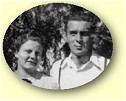
Paul and Nora
|
Oh, yes! In the interim, I had to get myself a drivers' license since I had never really needed to drive before. I took the test using Paul and Nora's car. I passed.
|
On July 17, our anniversary, I visited Bob and took a cake to him, "HAPPY 3RD ANNIVERSARY." The medic whom Bob liked very much was impressed that we had been married for three whole years.
I was nervous about using a car belonging to someone else, so Paul and Nora came over to trade back cars. I felt much better -- I had no idea how much longer this would keep us in Bremerton. Bob was not discharged until he was well enough to
return to full-time work, which amounted to a six-weeks’ confinement.
When we left for home we had had no salmon fishing and very little visiting with Dennis and Florence.
Dennis had hoped to get out of the Navy in 1941, but with the advent of Pearl Harbor, and WWII, he had to stay in until the hostilities were ended. He was a Lieutenant j g when he was discharged late in 1946.
Dennis' hearing was impaired during his service aboard ship. Listening carefully for code, he would often get a poor signal. Then, all at once, after having turned the volume on high, a signal would blast in his ears.
Opal, Bill and Kristi went to Birmingham, Alabama, to live. Bill had wonderful memories of his hometown. It was summer and terribly hot in Alabama. He also found the wages were not good. Opal and Kristi came home after three months and Bill stayed until he could make enough money for the fare back to Spokane -- about six months later.
February, 1947, Ricky was born to Opal and Bill; and in June, Leo and Phyl were now the parents of Lynn.
In April, 1948, Bill got a job at the Trentwood Rolling Mill where he worked many years until early retirement.
Also April 8, Bob quit the machinist trade because he had heard of radio work with the Navy at north Spokane. He went back full-time into the Naval Reserves, active duty. This base was located in the old Baxter Hospital, construction was authorized during WWII as many men came back not altogether whole, and were returned to the 1500-bed facility on Assembly Street. These buildings were converted for a USN Training Center. Bob was now very happy "doing his thing."
Barry was about two years old when he said to me, "Sister, Mommy? Baby sister?"
Barry was a January baby and my birthday was in January, so I wanted to have an April baby (Bob's birthday was in April).
We predicted correctly. Our beautiful baby girl, Nikki Lyn, was born April 23, and she weighed 8 lbs. 11 oz. This time I had a local injection and was able to be awake during the delivery. I began crying because I was so happy to have a daughter; happy to have participated in the birth; and happy to have it all over with. This baby was also five days late, and I had shots to start the labor. The nurses fussed over me, saying, "Your baby is so healthy -- she looks just like you, Mrs. Nance."
A five-day stay in the hospital was the usual for maternity. Barry came along with Bob to the Sacred Heart Hospital to bring me and the baby home. I was holding the baby and the nurse was pushing us in the wheelchair. Barry said, "I want that baby, Mommy." Barry was wearing a blue sweater that I had knitted. It had a row of owls (cables) knitted in its design. He looked so cute!
Nicole was the name I liked so she could be nicknamed Nikki because I liked the way it went with Nance. Bob Said, "If you're going to call her Nikki, name her Nikki!
Dr. Jerome Sweeny was my obstetrician. Nikki was one of his first babies. Years later, Nikki also had Dr. Jerome, so he delivered the very first baby of a first baby. Dr. Sweeny and his brother, Dr. Joe, were from an Otis Orchards pioneer family. They at later times both suffered heart attacks and died at an early age.
Darlene was born in August, 1948, to Dennis and Florence.
Opal and Bill had their third baby November, 1949. They named him Michael.
In the fall, Barry and Kristi were almost three years old. They were always playing together. Kristi fell of her trike and I heard her say, "I fell down and went boot!" Barry said, "I fell down and went 'boot' the last day." Kristi said, "I fell down and went boot the last day, too." Barry said, "No, you fell down and went boot to this day!"
Barry showed Nikki a toy he was playing with and said, "She thinks it' s pretty nice, doesn' t she? It happies up her face!"
At age 21 months, Nikki demonstrated her natural music talent. She sang, "I Wanta Go Home Wiss You." She sang the right notes and I realized that that song had just finished playing on the radio.
When he was four, I was explaining to Barry what a volcano was. He said, "Oh, yes! I saw one in Kristi's funny book, and it had all hot stuff running out of it." About this same time he saw a picture of a sphinx on a signboard and said, "That's a sphinx, Mommy."
"Two and two make four, " Barry said as he cut his toast into four pieces. He told me his Daddy told him that once. He was demonstrating his natural aptitude for math!
Then, in the livingroom, Barry was pretending he was a fish. He had taken his shoes off which he usually did. I said, "Why are you going around without your shoes?" I was told, "Because fish don't wear shoes!"
Our dog, Tubby, a dog we had had since we lived on Bainbridge, was poisoned. We didn't want Barry to feel bad, so we didn't say a word about it. Bob just went to the back of our land and buried the dog. Barry had been watching, but didn't seem disturbed, so we thought he hadn't caught the significance of the fact that Tubby had died. Several weeks later, George said to him, "Hey, Barry, whatever happened to Tubby?" Answered Barry sadly, "My Daddy covered my doggie upl"
Nikki was two and we were adding a third bedroom onto our house. Dennis was helping Bob with the carpentry. Nikki and I were inspecting the work from a window that was to become a door to the bedroom. The rafters were up. Nikki, looking up at the unfinished roof, suddenly said, "Oh, look at the house!"
Barry had frequent tonsillitis attacks. He was four and Nikki was two when I took him to Dr. Enterline's office for a shot. I had promised him a toy airplane from the dime store in Millwood after the shot. In the office he began crying for that airplane right now! Nikki seemed to think he was crying for a large medical machine which was standing in the corner of the doctor's office. She kept telling Barry, "It's too big sor you, Barry! Barry, it's too big sor you!"
In 1948, Leo and Phyl 's baby, Lynn, at nine months of age, was chosen Baby Inland Empire. Their daughter, Karyl, had previously won third then first prize in annual Baby Spokane contests. The initial judging was done by glossy pictures which were sent in.
|
So, at nine months of age, I entered Nikki's picture, and she received an honorable mention.
Trying again the next year when Nikki was 23 months old (two years old was the age limit) she was selected to come in for final judging.
|
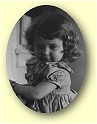
Nikki Nance
|
She looked to be a real doll wearing the gold-colored, ruffled dress that I made. I also made the petticoat hoop skirt for underneath. Her hair was naturally curly. She took her red purse with a supply of gum -- the idea being to keep her quiet. She was very affable and played with the other babies. Mom and Opal went with me to help.
Groups of 12 were taken upstairs before the three judges. She was chosen to return again for afternoon judging. She didn't really like having to stand on the judge's desk. She came away with a third prize -- a 5 x 7 copy of the picture we submitted, and
a letter of congratulations.
Another letter (not so welcome) arrived on the day after Christmas in 1950, and it began -- "GREETINGS" --